.png)
Y H & C Investments August 2026 Update
Under the Hood...
Aug 01, 2026
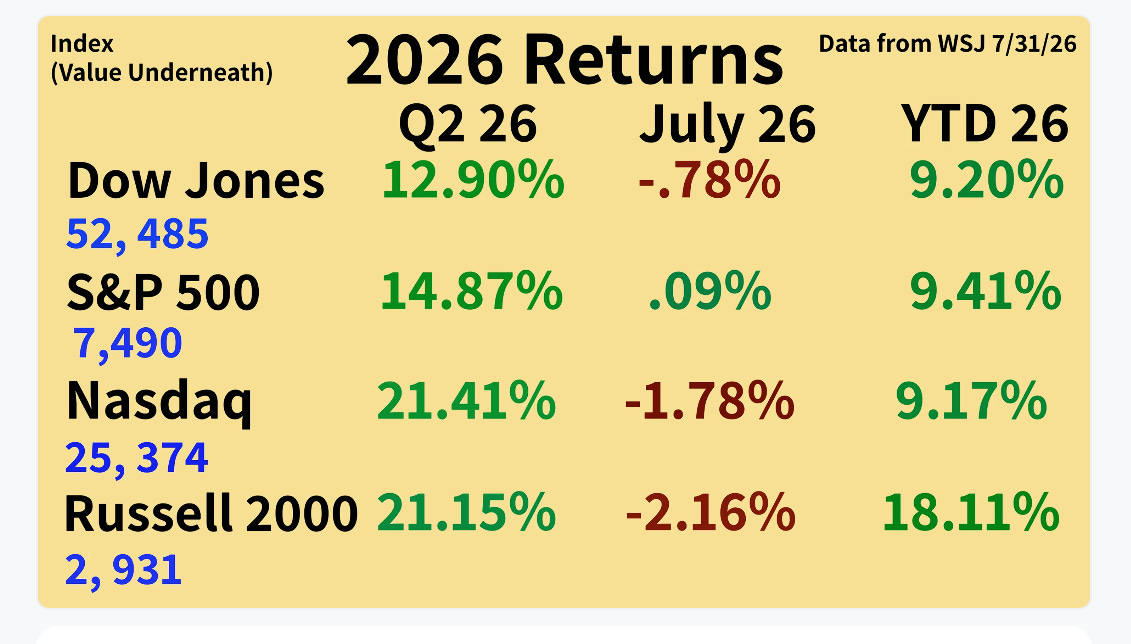
(Return figures come from the July 31, 2026, edition of the Wall St. Journal. Y H & C Investments may have positions in companies mentioned in this newsletter. Nothing in the newsletter should be taken as an offer to buy or sell individual securities. It is the responsibility of each investor to research the investments mentioned so they can decide on the appropriateness and suitability of the investments consistent with their risk tolerance, risk constraints, and return objectives.)
The first car I ever drove was a urine-colored Mercury Cougar. I was a teenager, and like most responsible parents, mine were concerned that if I made a poor driving decision, the car would be able to withstand an accident. I never had a problem in the Mercury Cougar, but not because of my driving ability. There was no accident because the car kept breaking down. For those of you who aren’t familiar with Las Vegas, for six to nine months out of the year, the weather is rather good but on the hot side. In the summer months, it is extremely hot. Yes, I know, they call this a ‘dry heat’, but 110 is tough. For example, this is when the air conditioning breaks. Anyway, on multiple occasions, when driving up a hill on one of the major streets, I would watch the engine die, steam gently rising out of the hood, the lights on the dashboard suddenly disappear, with the car stopping on the upslope of a hill. I would have to navigate the situation and get it towed to our local mechanic. Let’s call him Bill. He looked like a bulldog, you know, the little hounds with the squished-up faces. Bill was the typical automobile repair person in that he was more concerned with the amount he could extract from his vulnerable customer than the quality of the repair work he would perform on the now non-functioning ultimate driving machine. On many occasions, and you probably experienced this as well, you bring in a car for x repair, and the mechanic wants to fix not just x, but a, b, c, and the whole alphabet. Great. Let’s just see if we can fix X, ok? From this driving experience, and others, I have concluded that my best alternative is to own what I think are reliable cars

Share Y H & C Investments Weekly Blog & Monthly Newsletter
Many things can cause a car to stop performing, whether it has an internal combustion engine or electric. It could be the transmission, carburetor, alternator, belts, fluids, tires, oil, antifreeze, coolant, or who knows what else. For someone fixing cars, they must go underneath the hood and analyze what is wrong. It is much easier now because they put the car on the rack and, with sophisticated tools, can diagnose the problem. My man Bill is long out of business, and those who have replaced him have it much easier.
I mention this because, as an investor, it is worth your time to extensively research assets when allocating capital. Like today’s advanced garage with a complete set of diagnostic tools that analyze a car’s function, investors need an extremely comprehensive approach when considering where to put money. Today’s environment makes it extremely easy to click or tap a button and have yourself some stock, even one-tenth of one-tenth of one-tenth of one-quarter of a share. Just because you can buy something easily doesn’t mean it is something worth owning.
A simple question to ask yourself about owning any asset is: What is it about this that makes me believe it will be worth more in one, three, five, ten, or twenty years? This is the starting point for any investment, but just the beginning. Like the car owner with a non-functioning car who is dependent on his trustworthy auto mechanic to get it running, minority investors rely on the management teams of the companies they invest in. You want the best. You want to avoid the Bills of the world who have questionable backgrounds or come off as promotional. It is why part of your toolkit has to be learning about every member of the management team (CEO, CFO, Controller, President of Operations, VP of Operations) and the Board of Directors. Evaluating the quality of the people who run these organizations might be the most important aspect of your analytical process, although business quality must be right there as well. Like a car owner who drives a vehicle for ten or twenty years, you want to own assets for a prolonged period that will create wealth for you. A comprehensive and rigorous approach when researching and analyzing assets helps make this happen.
Spanning the Globe: Is the KOSPI the Canary?
The KOSPI is South Korea’s main stock market index and is the benchmark that is representative of the largest listed companies in South Korea. July proved to be a very volatile month for KOSPI investors as the index suffered from massive concentration, with Samsung and SK Hynix representing over 50% of its value. Even more concerning is the amount of leverage used by KOSPI investors, who have piled into leveraged single-stock ETFs. Guess which company ETF’s they loaded up on? Margin debt recently broke records as the total amount of margin loans currently added up to over two trillion won, and the typical historical amount is a little under half that figure. For indications of volatility, the KOSPI has lost a quarter of its value since late June. Even more difficult, by July 13, more than 1.2 million accounts were hit with margin calls, and 320,000-360,000 have been closed through forced liquidations by brokers. The liquidation rate is normally 2.1% but reached over 10% in July. This has affected one in thirty of all South Korean adults. Ok, other than many South Koreans with less of an appetite for Kimchi, so what?
Well, let’s look at what is currently transpiring in the US markets to see if there is anything similar taking place. Is there a concentration of value in a few companies? Uh, hello, earth to investors, but yes, the answer is clearly yes. It’s not in two, but more like ten. Increased leveraged single-stock ETF popularity? Check. Margin debt expansion? According to Convextrade, as of June 30, 2026, U.S. retail margin debt stands at about $1.50 trillion — near all‑time highs and well above historical norms, with leverage 4% of GDP, surpassing the 2021 peak. Seems similar to me, eh? However, US markets have many companies with high rates of earnings growth, and that is typically what is needed to support high valuations. Also, we have far deeper and broader markets with a plethora of industries to create value. Still, if you are using leverage to buy securities, remember the old Warren Buffett adage, “Only when the tide goes out do you discover who has been swimming naked.”
Share Y H & C Investments Weekly Blog & Monthly Newsletter
Y H & C Investments Firm Update- Sector Rotation, Long Term Holdings Perform Well, A Site Visit, Small Microcaps Report Solid Numbers, and the End of Summer
July was an interesting time in the markets as we started to see the inkling of a shift in capital flows from the leaders, which revolve around the hyperscalers, semiconductors, and storage industries. It flowed towards health care, energy, financials, and selective consumer discretionary-related names. Within our holdings, a West Coast-based REIT reported expected numbers, and a few of our long-time holdings in the health care and consumer discretionary sectors posted particularly good results. I took a site visit to a company we have a nice position in and spent quality time with a few senior management members. The company has struggled over the last few years, and even so, is consistently profitable and led by people I have a great deal of confidence in. A site visit is typically a good learning experience, and it was on this occasion as well.
A few smaller microcap holdings have had nice months as two community banks posted good figures and investors rewarded both, one much more so than the other. Stock buybacks have helped a large position in the foreign exchange area and a smaller situation in payment processing. Next week will be a big week for earnings as we have quite a few portfolio companies reporting.
Interactive Advisors GARP Models-
In July, the Concentrated GARP model had a good month as our large payment processing entity rebounded some, a few long-term holdings reported solid numbers, and the investment world noticed a little bit.
In Long Term GARP, it was a similar story as our biggest position in financial services also saw a strong bounce. As mentioned earlier, long-time holdings in health care and consumer discretionary added to the portfolio gains.
Thank you for reading the August update. If you have any investment questions, please reach out to me at information@y-hc.com. I really appreciate your interest and thank you for your valuable time.

.png)