.png)
Y H & C Investments June 2026 Update
You Gotta Have Heart-
May 31, 2026
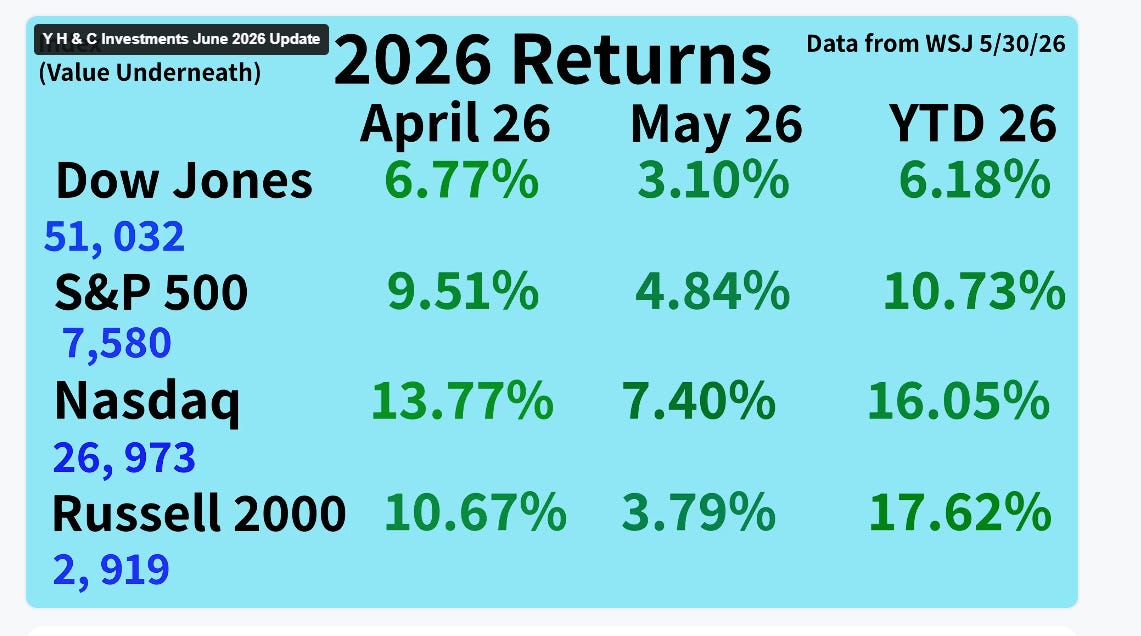
(Return figures come from the May 29, 2026, edition of the Wall St. Journal. Y H & C Investments may have positions in companies mentioned in this newsletter. Nothing in the newsletter should be taken as an offer to buy or sell individual securities. It is the responsibility of each investor to research the investments mentioned so they can decide on the appropriateness and suitability of the investments consistent with their risk tolerance, risk constraints, and return objectives.)
In competitive sports, there are often lopsided games where one team is superior to the other. As an example, the Super Bowl has often turned into an absolute thrashing, like what the Seattle Seahawks did to the New England Patriots this year. It happens in many contests at every level, from grade school to professional athletics. During these games, when one team is losing badly, coaches can do one of two things. They can continue to search for ways for improvement, both by the players who play and how the players execute what has been practiced, or they can accept defeat without adjusting the group’s performance. During these occasions, attentive and intelligent coaches give scrutiny to which players work harder to perform what is being told. Anyone can execute when a team is winning by thirty points. The most difficult situation is when a team is behind by thirty points, and the belief is, well, let’s call it waning.
Share Y H & C Investments Weekly Blog & Monthly Newsletter
Joe Montana and Tom Brady, the two most successful quarterbacks of the last century, both were in situations, either in college or professionally, where they were stuck deep on the bench, call it fifth string or worse. It means they had to wait for an opportunity to play, and they only got it when the team had a difficult situation. Eventually, they earned their chance to play, and when they got it, capitalized on it. Why is this pertinent for investors?
It is well documented that the most successful investors are correct around 55-60% of the time. It means that nearly half of a portfolio will have assets which have underwater prices, meaning losing money if they are sold. If one were to look at the magnitude of loss, on some occasions a position can lose well over 25% of its value. Extreme volatility in the market is always present. For example, this week, we saw a situation lose over 70% of its value because the company announced the potential loss of a contract of ten percent of its revenue. It is a billion-dollar company that is very profitable on almost every metric. When you own stocks, you have to realize your companies are going to go through fluctuations in their performance. Most of the time, their operations aren’t going to be running perfectly. The important question is why do you own it in the first place, and what is the company doing to improve the business? In nearly all cases, management teams have plans which explain what is being done and why. As an investor, you must know those plans as well or better than the rest of the investment world. When others are nervous and want to sell at a price which makes no sense, you are there waiting to buy their shares. You also should try to have a particularly good understanding of the largest shareholders of the company. If they decide to sell, their actions will affect the price of the stock. They may have personal reasons for selling, or it may be related to some kind of conflict or difference of opinion within the company. You will not know this. Again, the question is whether you believe in the underlying premise of why you own the business and your faith in the management team. Owning a stock is not like being an athlete who is playing in a losing game because there are financial circumstances involved. Still, the ability to be patient, hang in there, and do your best when the game, or market prices, are going against you, is very much a major part of investing.
Spanning the Globe: US and China Meet, Iran Conflict Drags On, and India
In May, the United States and China met in China to discuss a wide variety of issues. One obvious topic is China’s exposure to the Strait of Hormuz and how much energy it imports from the region. China has a strategic interest in maintaining good diplomatic relations with all global countries that export oil and gas. With China dependent on others for the sourcing of feedstock, it is vulnerable to any disruptions in supply. Hence, the move is to protect its teapot refiners and find ways to increase non-carbon-based transportation vehicles.
With respect to the ongoing discussions and back and forth between the United States and Iran, the endless negotiation leaves the financial world vacillating between believing a deal is imminent versus a world where kinetic activity is the only way this conflict can end. My own feeling is Mr. Trump was deeply affected by the downed airplane and potential capture of US airmen earlier in the year. His dramatic shift of giving the Iranian regime an endless number of chances to have common sense, only to be disappointed with the scorpion being a scorpion, makes it hard to believe he won’t eventually find a way to get to a deal. I hate to say this is the case, but how could anyone believe differently?
India is a massive market and has been a strong performer for many years. However, the artificial intelligence wave leaves much destruction in its wake, and the Indian market is one of the victims. Foreign investors have longingly turned towards anything related to semiconductors and memory, so South Korea, Taiwan, and Hong Kong all offer companies that are heavily involved with artificial intelligence fundamentals and infrastructure. Valuation and liquidity are also concerns with the India market. Curious investors certainly should pay attention to what is going on there.
Share Y H & C Investments Weekly Blog & Monthly Newsletter
Y H & C Investments Firm Update- Two Kinds of Businesses
One of my favorite sayings about investing and business is that there are two kinds of businesses: Those that have problems and those that are going to have problems.
Recently, our holding of one of the largest energy companies in the world took it on the chin because of a variety of factors. The first is the perception that oil prices are headed dramatically lower when the US and Iran finally finish their long-awaited peace deal to open the Strait of Hormuz. The next was unexpected, as the recently appointed Chairman was suddenly dismissed by the company. Now, lawyers have been hired while the new CEO, a highly regarded executive appointed by the fired Chairman, is left to continue the job of making the company more efficient. This is probably a hiccup, as things appear very bright for this company, which has recently done well after underperforming peers for a long time.
Adding to this challenge is another situation with a holding that has been a great company for a long time. Located in the financial services and software domain, anything related to software is grouped into the category of ‘sell’ because of the potential business model vulnerability to artificial intelligence and large language models, along with the agentic trend. Having reported a strong quarter with a little weakness in its tax segment, investors saw what they wanted and sold the stock off, a frequent occurrence over the last year. In applying my point from the opening section, this company has made us plenty of money over the last few decades, so adding to the position made sense.
Turning to the small and micro-cap area, I had a wonderful time at the LD Microcap conference in Los Angeles, CA, which is always fabulous. What was different about this one was the numerous meetings I had with companies where the obvious value was so evident. There are plenty of attractive situations, but the caveat is that there is only so much capital available, and the enterprise must make sense and be suitable for clients or our company. Suitability is always a factor for any investor who has fiduciary responsibility to their investors. As I have said to many executives, just because the story makes sense and is attractive does not mean I am going to become a large shareholder (or even a small one). Usually, if everything checks out, taking a small starter position is a reasonable approach. Over time, as a company proves its merit, the position earns more capital. With respect to my opening point, trusting the management teams with small companies is nearly everything, along with business quality. There are a few positions which have had a tough six months or so, but I have utmost confidence in the leadership and their businesses.
Looking at June, the middle of the month brings the Planet Microcap Las Vegas event to the Bellagio. My meetings are set with many companies we own and have great familiarity with. Many of the featured speakers and investors are people I know and have good relationships with, so it will be nice to see them, along with friends in the investment community.
Interactive Advisors GARP Models-
In May, the Concentrated GARP model was slightly ahead, as not much changed in the composition of the model. June is expected to see some liquidity events as two positions are scheduled to complete their buyouts.
In Long Term GARP, it was a challenging thirty days. We previously mentioned the events of the major energy company and large financial services entity. I took the opportunity for some profits on a regional refiner and redeployed into the latter as it has an incredible business that I believe has many years of growth ahead.
Share Y H & C Investments Weekly Blog & Monthly Newsletter
For more information on the models-
Y H & C Investments: Concentrated GARP Investment Portfolio - Interactive Advisors
Y H & C Investments: Long Term GARP Investment Portfolio - Interactive Advisors
Thank you for reading the June update. I really appreciate it. If you have any investment questions, please reach out to me at information@y-hc.com.

.png)