.png)
Y H & C Investments October 2026 Update
The Secret to Life is.....
14 minutes ago
(Return figures come from the September 30, 2026, edition of the Wall St. Journal. Y H & C Investments may have positions in companies mentioned in this newsletter. Nothing in the newsletter should be taken as an offer to buy or sell individual securities. It is the responsibility of each investor to research the investments mentioned so they can decide on the appropriateness and suitability of the investments consistent with their risk tolerance, risk constraints, and return objectives.)
In today’s advanced technological world, the world moves faster. Information is available in milliseconds and makes us more productive. Still, I have my daily routine, which remains consistent, and I would imagine that holds for most people. Your habits and structure are ingrained in when and how you do things, and the quality of your work is affected by how things are set up. As an example, the person who works quietly in the calm of the early morning might have a completely distinct experience from someone who is surrounded by an active work or family environment in the afternoon or evening. People have their typical schedule and often do not stray from it, with the occasional event altering what takes place.
From a statistical point of view, most of the time we exist at the mean, or the average. We are operating in an area which is usually comfortable, and we can depend on. An emergency would be considered a two- or three-standard-deviation event, like going to the hospital because of an accident. It happens infrequently, and it often raises our stress level way beyond what we want. Who hasn’t experienced the stress of that phone call when you must drop whatever you’re doing to make the pressure-packed ten-minute drive to meet some deadline you had not ever considered? Not fun.
Why do I mention this, and how does it pertain to investing? It has to do with what one is expecting out of your assets. As an example, if you own a bond (fixed income instrument) of any kind, you can expect interest payments on certain dates, depending on the specific issue. When the bond matures, you know the original principal amount being repaid. When it comes to stocks, if you are paid a regular dividend, it is sent either quarterly or semi-annually, so you can expect that money every three or six months. In both examples, the payments depend on the operations of the specific entity, either a business or a government organization, to generate the income that makes the distribution.
The operations of these entities have historical operating metrics that are factual. We obtain this information for periods to help us understand how well it grows and what events took place to change the nature and size of the enterprise. When you look at any entity, you should be able to create an expectation range of what its operating performance will fall in, especially from a revenue and margin perspective. If you understand these probabilities and ranges, you then compare them to historical performance to get a better understanding of how the business is executing. We then look at its nearest competitors; well, now we might have improved our chances of owning something that is operating more efficiently. The key point to emphasize is that most of the time, what you own will operate in a typical range, maybe a little better, maybe a little worse. Much of the time, companies are not firing on all cylinders. They are not going to grow revenues and profits at over 20%. Expecting anything different is just going to lead to disappointment.
Share Y H & C Investments Weekly Blog & Monthly Newsletter
It is interesting to see how different corporate executives communicate their expectations to the investor community. Obviously, some of that depends on the size and strength of the company they represent. Small companies are starved for investor attention and capital and often feel the need to use whatever means necessary to create an audience. It is my experience that executives who are bombastic and create outsized expectations are to be avoided, as investors hate those who overpromise and underdeliver. Similarly, just because an executive is understated and reserved does not mean they deliver excellent results. The most professional approach is to present the company, its potential market, the range of expected results for the year, and how they evaluate their own performance based on what they have communicated in the past. Sometimes they will do better, sometimes worse. Regardless, they are clear about the opportunity, how they plan to capture it, and how well they have executed on it.
From the investor perspective, the key is to not have excessive expectations for any company or your portfolio. Expecting 20-30% improvement each year, or huge returns in any one year, is just setting yourself up to be upset. Yes, we want our companies to try and achieve those results, but expecting them is not a rational approach. Additionally, reacting to outsized moves in markets or individual positions based on a single day needs to really be tempered with an understanding of the company within the context of the entire portfolio. Yes, we want to be opportunistic when the market gives you a good look at a great business, but you want to do so on your terms. Remember, in most holdings, you want to own the asset for a long time frame, not for a quarter or year, but when they are good holdings, for many years or even decades. Munger always said the secret to life is low expectations, and they are good words of wisdom to remember and adopt. Not easy, but nothing worthwhile is.
Spanning the Globe: Majors Pile in To Venezuela, Canada Looking at an Associate Member of the Eurozone, and An Opportunity in Japan-
Over the last month, there has been a series of announcements by the largest oil companies in the world about their willingness to spend a little bit of their resources in Venezuela. The thesis is to gain a foothold in reinvigorating the largest proven fields in a country with the biggest oil reserves anywhere in the world. A few of the companies with recent announcements include Chevron, Shell, BP, Repsol, and ENI.
The love affair between two geographies with more than a little antipathy towards the United States took an interesting twist as the European Union took a step towards considering Canada for ‘associate membership’ in the EU. Interestingly, the consideration would not involve EU citizenship, single market access, or the same voting rights as full members. The announcement was merely an initiative to consider the possibility for Canada. Birds of a feather flock together.
One country to look at for investment consideration remains Japan. The thesis is that the weakness of the Yen gives investors the possibility to gain exposure to the currency with the idea that when it strengthens, a holding with a yen-rich balance sheet, a business whose functional currency is the yen and whose revenues are dependent on yen, will benefit substantially from the currency’s appreciation. Here are some opposite perspectives on the matter-
Y H & C Investments Firm Update- Tough Month for Markets as $100 Oil and 10 Yr Treasury Create Obstacles
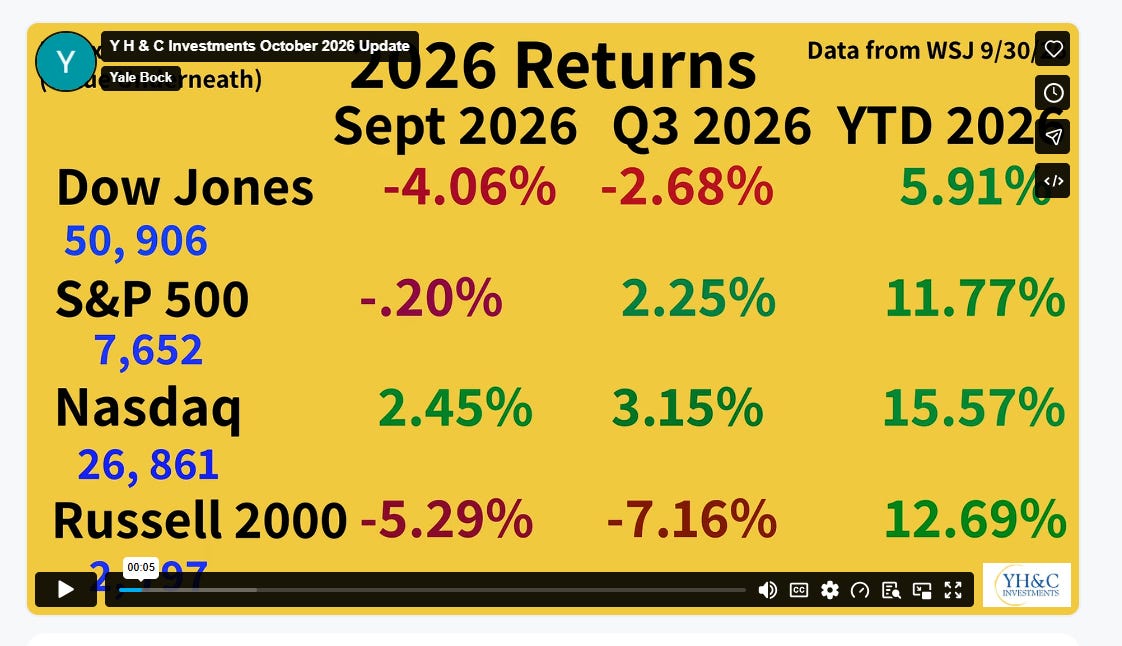
September is historically a challenging month in capital markets, and the past month provided a strong headwind for equities. With oil breaking the century barrier and the always important ten-year Treasury yield breaching 5%, along with Meta releasing its new price comparison agent, investors found reasons to sell risk assets. Across our holdings, interest rate-sensitive sectors like real estate and anything consumer-related have struggled, along with the whole small and microcap complex. Over the last six weeks, the one area which has stood up well is energy. With Chairman Walsh deciding to raise interest rates at the September meeting, investors are looking at the rest of the year, wondering when the hiking cycle stops. Given that inflation has stayed flat or risen for five consecutive years, one and done is probably not in the cards.
Share Y H & C Investments Weekly Blog & Monthly Newsletter
With respect to specific holdings, one of our REIT holdings saw large insider buying from the founder, which is a nice sign. A conglomerate with a major position in the MGM Grand was rebuffed in its effort to take it private, and there are now rumblings that MGM will make a bid to buy out the company, which has a plethora of assets that can be monetized or digested. Stay tuned. In the microcap area, we had quite a few calls with companies at both the Sidoti and Lytham online conferences. The vast majority were excellent. One stood out in particular because I learned why a large seller of the equity was proceeding with that activity. When you understand the history and background behind what is transpiring, you can accept the circumstances if they make sense. In that regard, one of the most frustrating things for any investor is to see corporate executives give presentations about creating shareholder value for the long term, and then to watch them dumb stock for months on end. If board members and corporate executives don’t believe in the company and don’t want to own the equity, arrange a buyer for their shares, and/or replace them with people who do believe in the company.
Elsewhere, our community banking positions held up nicely, with one West Coast-related holding announcing an uplisting to the Nasdaq. The foreign exchange holding reported earnings and is continuing its buyback, and other micro holdings are also continuing theirs as well. Quite a few buyouts or mergers have been taking place across the microcap landscape as the prices for many equities are lower on any metric than in any other market segment.
Interactive Advisors GARP Models-
A quick mea culpa as I inadvertently forgot to include this section during the last update. My apologies, and I will do my best to make sure it is included in future updates. And now back to your regularly scheduled programming——
In August, the Concentrated GARP model had a flat month as the holdings were up a little over half a percent. Like the rest of the market, September was a challenge, with the payments and real estate sector taking it on the chin, and the result was down 5%.
For Long Term GARP, August was a solid month with a gain of 1%. As the selloff in software entities accelerated in September, the portfolio declined 11.8% for the month. It is the nature of a concentrated portfolio to experience wide fluctuations in performance, so having a strong stomach is obviously a prerequisite for ownership.
Thank you for reading the September update. If you have any investment questions, please reach out to me at information@y-hc.com. I really appreciate your interest and thank you for your valuable time.

.png)