.png)
One Trick Pony or Multi-Dimensional?
Aug 31, 2026
(Return figures come from the August 31, 2026, edition of the Wall St. Journal. Y H & C Investments may have positions in companies mentioned in this newsletter. Nothing in the newsletter should be taken as an offer to buy or sell individual securities. It is the responsibility of each investor to research the investments mentioned so they can decide on the appropriateness and suitability of the investments consistent with their risk tolerance, risk constraints, and return objectives.)
When I was in high school in the 1980’s, my favorite football team was the San Diego Chargers. Whenever they scored a touchdown, this fabulous song would come over the loudspeakers and blare, “San Diego Superchargers, San Diego Superchargers,” and the mascot would run around the field in his loud, lightning-bolt team garb. The team scored quite often, and the song blared incessantly. Led by a small, tough Oregon quarterback named Dan Fouts and offense-minded coach Don Coryell, the team put together an incredible scoring machine. It had great wide receivers with John Jefferson, Wes Chandler, and Charlie Joyner. It had a superb tight end in Kellen Winslow. They had diverse and dynamic running backs with Chuck Muncie and James Brooks. They were exceedingly difficult to stop for many years. Defensively, they had talented players up front, with linemen like Gary ‘Big Hands’ Johnson, Fred Dean, and Louis Kelcher, so they could pressure the opposing quarterbacks pretty consistently. However, the linebackers were a touch undersized and slow, and the secondary, well, let’s just say that Swiss cheese had fewer holes.
The Chargers put together many seasons with winning records and division championships, even reaching two conference finals. In one game, the weather was a jillion degrees below zero as they played the Cincinnati Bengals. The Bengals ran the ball down their throats and took a quick lead, and with the climate making passing impossible, well, the Chargers didn’t have much of a shot. The other Super Bowl possibility was played on their home field against the Oakland Raiders. Again, the Raiders ran and passed at will against a porous San Diego defense. The San Diego offense kept it respectable, but in the end, the Raiders had too much. The San Diego Chargers wound up going to the Super Bowl many years later, but never saw one under Don Coryell. I mention this because it has an impact on how I think about investing.
Share Y H & C Investments Weekly Blog & Monthly Newsletter
In many ways, businesses are like teams. They each have leadership and possess strengths and weaknesses. In different team sports, there are examples of franchises and organizations that have had incredible success. You can think of the New England Patriots, San Francisco 49ers, Pittsburgh Steelers, and Denver Broncos in professional football. In professional basketball, the Chicago Bulls, Boston Celtics, and Los Angeles Lakers stand out. In college football, Alabama, Ohio State, USC, and a few other schools typically reign supreme. In college basketball, it is Duke, Connecticut, UCLA, Kentucky, and, years ago, Indiana, which earned championships on the hardwood. These teams had top-notch leadership with strong coaches and few weaknesses. Typically, there were many outstanding individual players who contributed on both offense and defense to help the team win. Very rarely, if ever, was a championship group dependent on one player or were one dimensional.
In applying this observation to investing, we are looking for unique situations by owning businesses with excellent management teams that have multiple aspects contributing to the business model. Often, the revenues are either transactional and/or recurring in nature. You can think of commercial and community banks, investment banks, payment and payroll processing firms, billers, custodians, cable and wireless companies, and a few quick service restaurants. Conversely, I am not interested in one-product companies or enterprises that are trendy or seasonal in nature. Many clothing- or fashion-related companies fall into this categorization. Energy and utility entities can fall into either group. When I use the term unique, there is typically something rare that the business possesses. It is their brand, intellectual property, broad distribution, or possibly the location of the assets it owns, like real estate-related holdings. Regardless, it has multiple revenue streams to contribute to growing the enterprise value, and they are advantaged relative to the competition. Like sports, business and investing is extremely competitive, and it is particularly challenging to sustain long periods of success. However, by choosing entities with advantages on multiple different business dimensions, it gives our investors a higher probability of success.
Spanning the Globe: North American Countries Face Different Energy Challenges and Approaches
There is the idea that energy is destiny. If this is true, the major countries of North America each have circumstances to contemplate when considering their future energy needs. Obviously, the United States sits in the center of the North American map. It is the world’s largest producer of oil and gas but still receives some imports from Canada and Venezuela. Some believe the large onshore shale fields in the US, like the Permian, Bakken, and Marcellus, are now at a point where production is plateauing and will start to decline soon. In that context, President Trump’s recent announcement of a deal with Venezuela giving the United States access to their major oil basins certainly addresses the issue of future resource reserves. It remains to be seen how much production the United States will receive from the Venezuelan fields.
Canada has a strong resource position because of its large tar sands and other oil and gas fields, which are in Alberta and Saskatchewan. The United States imports a little over 10% of all energy used from Canada, or 60-80 percent of total energy imports. With the recent tariff controversy between the United States and Canada, some energy experts believe Prime Minister Carney will use the country’s anti-Trump mood to create the impetus to build long-needed pipelines going east and west across the provinces.
Of the largest countries in North America, Mexico has the most difficult energy position. As it moved to nationalize energy resources, production has suffered dramatic declines over the last decade. Mexico has long been ruled by political leaders who have worked to take national resources out of the domain of private industry and is now faced with the consequences of that approach. The financial problems of the state-owned energy company PEMEX highlight these decisions.
Of the largest countries in North America, Mexico has the most difficult energy position. As it moved to nationalize energy resources, production has suffered dramatic declines over the last decade. Mexico has long been ruled by political leaders who have worked to take national resources out of the domain of private industry and is now faced with the consequences of that approach. The financial problems of the state-owned energy company PEMEX highlight these decisions.
Y H & C Investments Firm Update- Refiners Rock, Earnings Calls Inspire Confidence, and Small Holdings Show Promise-
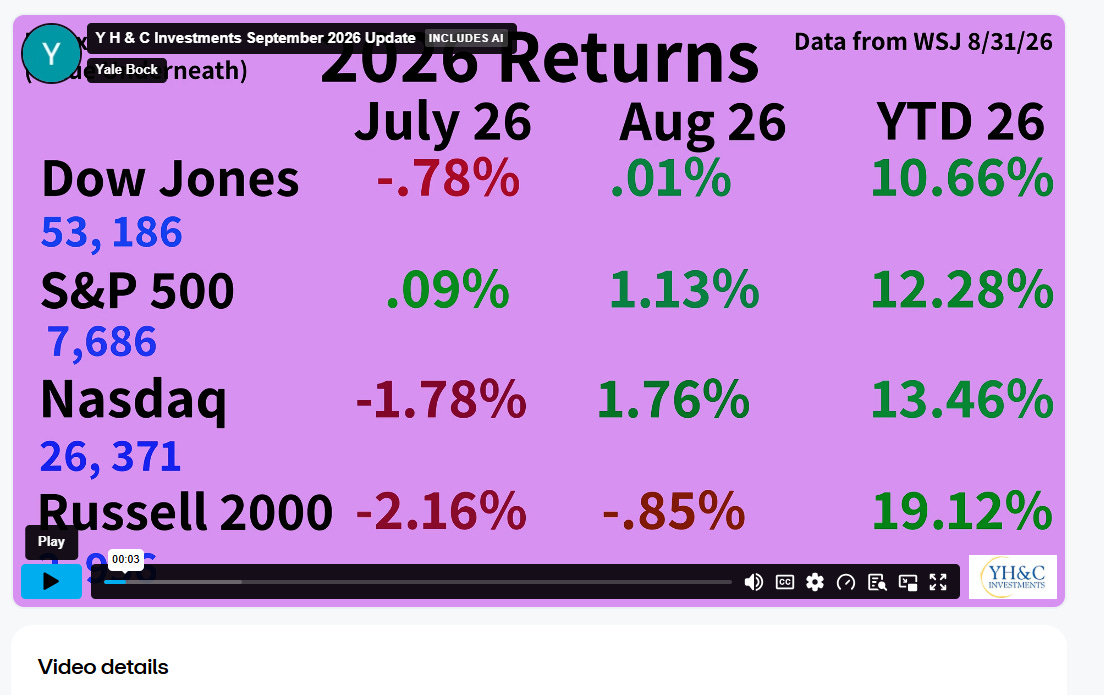
August is typically a volatile month in markets as volumes dry up and are usually one quarter or one-half the normal trading volumes. The month went well with our companies as our refining entities reported excellent numbers and moved higher. One entity sold a 40% controlling stake in a gas company for a little under $500 million, and the deal should close by the end of the year. Across nearly all our major holdings, earnings calls were positive, as was the future outlook. Let’s categorize their business efforts as either organic or inorganic. The first means growth efforts related to existing business operations. The second is anything related to outside acquisitions or merger candidates. The same patterns emerged as our companies typically have multiple internal efforts to create higher growth rates from new revenue opportunities. Companies are also either involved with acquisitions or actively looking for candidates that make sense. On the capital allocation front, many companies are opportunistically buying back their stock, and that holds for our small- and micro-cap holdings as well. A few companies are on pace to retire five percent or more of their outstanding shares over the course of the year. When answering questions from analysts on the earnings calls, the leaders inspire investor confidence with the answers about the challenges they face. One has to be cautious and view the future with a sober and realistic view about what lies ahead, but I remain confident about what we own. In terms of where to look for allocating capital, markets now believe the Fed will move interest rates higher at the next meeting in September. As such, real estate-related entities have sold off. The legal and payment industries are also trading near the bottom of their ranges.
With respect to our micro-cap holdings, a community bank position doubled, and a payment processing entity also jumped higher after a strong report. The community banking situation is a textbook example of what happens when the management team has worked for a long time to build a business that can create value. The capital structure is excellent, and the two largest shareholders own 75% of the equity. The leadership team is stable and has been together for a long time with no changes. The same story has been told repeatedly for the last few years, and the last quarter showed excellent growth in revenues and profits. The leaders show up at every conference they feel is worth attending, and present professionally and answer all questions positively and respectfully. For two years, the equity did nothing, but over the last month, it has moved meaningfully higher. The company has plenty of opportunity to grow for a long time and create more value.
With the microcap area, I have a nice roster of companies which I monitor and have positions in. Many require years of attention before they earn more capital investment. One of the problems that investors constantly face with the smaller entities is turnover in the management teams, either with the CEO, CFO, VP of Finance, VP of Operations, or the investor relations person. Any of these changes do not inspire confidence and typically drive investors away. On the other side, when a management team shows up with the same leaders and makes an enthusiastic effort to tell their story about why the company is going to grow and what they are doing to address the always-present challenges any business faces, they are giving their shareholders a chance to benefit. Fortunately, nearly all our holdings belong in the latter camp.
In September, we will be attending the LD Microcap event in San Francisco, and October will be a busy month as there are conferences in Los Angeles and Toronto to participate in. Thank you for reading the update; I really appreciate it. If you have any investing questions or comments, please email me at information@y-hc.com and share your opinion, as I’m always interested in hearing your thoughts. Thanks again for reading, and I hope you have a great month.

.png)